
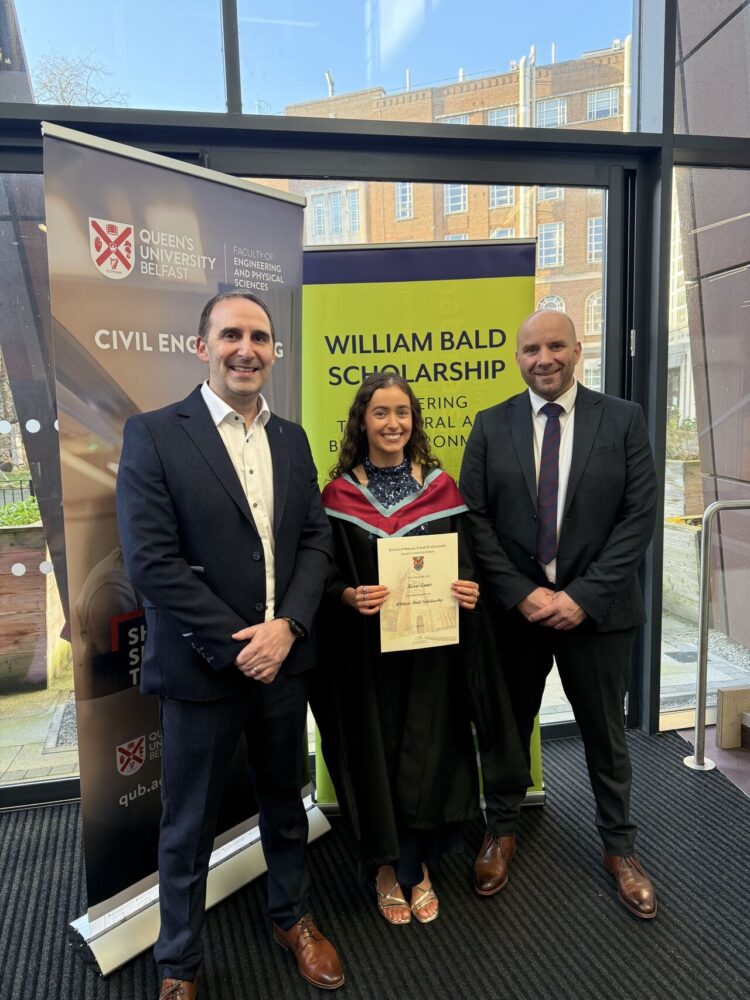
William Bald Scholarship presented for innovative solution to harmful algae blooms in Lough Neagh
Farrans has once again jointly sponsored The William Bald Scholarship, an annual award for two students, one from Ulster University and Queen’s University, each with a value of £750.
Four candidates were put forward by Queens University Belfast with their award presented to Masters student Kerri Ennis of McAdam Design who designed a pilot floating solar–UV hybrid system to help tackle the harmful algae blooms present in Lough Neagh.
The two scholarship award winners are required to ‘share knowledge’ gained via a written paper and presentation to the sponsoring organisations – Farrans and Graham.
David Orr, a graduate of Queen’s University Belfast assumed office as President of the Institution of Civil Engineers in November 2007. In his Presidential Address he spoke of the profession’s “unsung heroes … who work in teams and partnerships, often unrecognized, to create and maintain the essential fabric of our society”. He chose the little known William Bald, who, between 1832 and 1842, engineered the 38 km Antrim Coast Road that provided an invaluable trading link for the people of the Antrim Glens, to illustrate this theme.
During David’s year in office, he also sought to boost: professionalism, competence and knowledge sharing in civil engineering. This scholarship was set up by David’s civil engineering colleagues from industry and government as a tribute to the work of the ‘unsung heroes’ who have done so much in building and maintaining the infrastructure essential to Northern Ireland.
Recognizing David’s involvement in roads and transportation throughout his working life, including an MSc for research on pavement management systems, and later studies in Canada, Germany and Holland on design and construct techniques, this scholarship was to be awarded to recognise excellence in dissertation studies at Masters level in Civil Engineering or allied professions
Eligible courses at QUB include all Masters programmes under the control of the Civil Engineering Exam Board. Typically, the Civil Engineering Exam Board, in consultation with the programme director for each MSc programme, will nominate a minimum of 1 and maximum of 3 students from each programme for the award, based on their final score in the dissertation module. Nominees will then be interviewed by an external panel, drawn for the local civil engineering profession and normally including representatives from the sponsoring companies, to determine the outcome of the award.
The Scholarship is independently administered by W Alan Strong, Visiting Professor in Civil Engineering, Ulster University.